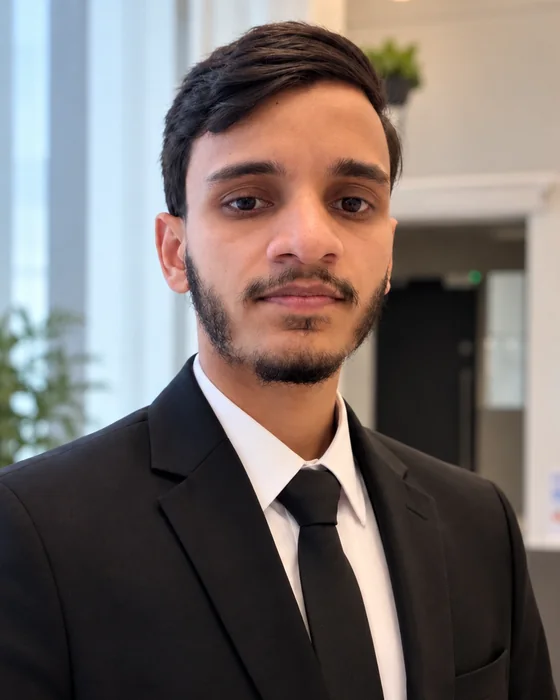
I’m driven by curiosity: how things work, why they fail, and what I can build with them.
From experimenting with Windows and Linux as a teenager to leading the build of an AI agent for a local council, I enjoy finding a practical way through a difficult problem.
NowOrOgins rebuildCore technical work on a strategy game and its AI, in a small team
Final-year projectTechnical LeadA multi-service AI agent prototype for Bradford Council
DegreeFirst-Class HonoursBSc Applied Artificial Intelligence, University of Bradford, 2026
Now
What I’m working on
Screenshot · September 2026
Rebuild · June 2026 – present
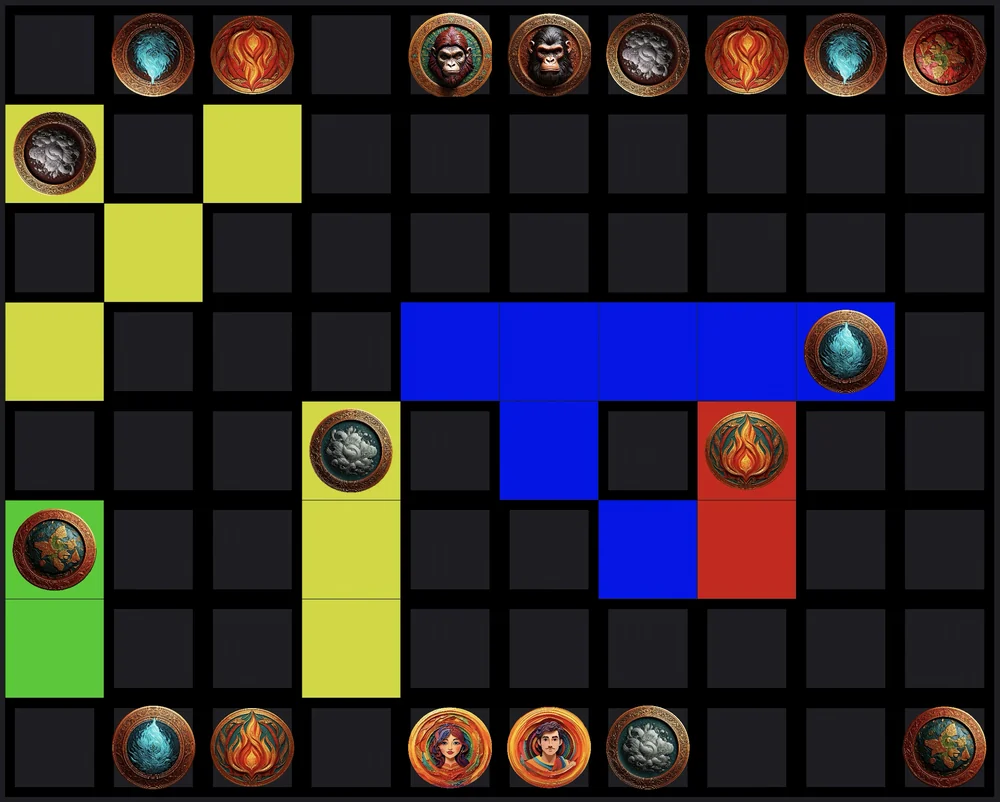
OrOgins: the game and its AI, together
Core technical work with Shafan · Project Manager: Dr Kulvinder Panesar
My Year 2 game never met its AI. In the rebuild, a Python engine that follows the original rules drives my Unity game, and a 12-weight Hard AI plays against you.
Still needs a local Python server. Moving the rules and AI into C# for offline, Steam, itch.io and browser builds is under way.
Bilingual Arabic and English conversational AI, by voice and text, designed for places where the network cannot be relied on. I co-lead the project and develop its conversational AI.
Under an NDA: the page covers the problem and the kinds of design responses, with no system details.
A personal experiment in coordinating agents and approval steps to build applications and services. I am exploring how these workflows could run with local language models.
Builds on OpenClaw, an existing open-source platform. Not on GitHub; local-model support is still being explored.
That curiosity is still what drives me. I enjoy experimenting, finding a different way into a problem, and understanding why something works.
“I thought of software as the computer’s soul.”
On getting my first computer, around the age of ten
Around age 10
A computer, and a lot of questions
My first computer made me curious about how one machine could do so much. I wanted to understand each component, and how software gave the hardware its purpose.
Ages 12–15
Learning by trying things
Windows XP was where it began: installations, drivers, BIOS settings, booting from CDs and USBs, then Windows and Linux on the same machine. Frustrating at times, and I enjoyed working it out.
2023
A new chapter in Bradford
I moved to the UK in January 2023 and completed my foundation year at the University of Bradford International College that September. Computer science gave structure to years of curiosity.
2023–2026
From how computers work to how models learn
Machine learning pulled me in: optimisation, learning rates, batch sizes, the choices that change what a model does. My Applied AI degree moved from single models to connecting them into software. I graduated with First-Class Honours.
2026 –
Building AI systems
I do core technical work on the OrOgins strategy-game rebuild in a team whose Project Manager is Dr Kulvinder Panesar, co-lead a conversational-AI contract, and in my own time experiment with agent orchestration and think about how organisations should govern AI.
The dashed stretch is the move from home to Bradford.
Selected work
Projects, and what I did in them
Final-year client project for Bradford Council · 2025–26
Citizen Support AI Agent
A prototype that answers council-service questions from public Council pages and guides residents through bounded tasks, such as finding a bin day or booking an appointment, in one conversation. I was the team's Technical Lead.
Proposed building on public Council pages, then selected the service pages and built the crawler for the knowledge base.
Drafted the code structure, built the first MVP and the school-finder, appointment and council-tax workflows; co-built the bin lookup.
Led delivery as first-semester Product Owner and Scrum Master for Sprints 2 and 4, alongside deployment on AWS EC2.
ScreenshotThe prototype's web interface, April 2026.Simplified Every message passes C# checks first; only then does it reach a workflow or retrieval over Council pages.
From first-year prototypes to structured experiments
Year 1 team project · AI Project Design and Development
The same ten queries worded four ways, including misleading ones, against a frozen CLIP model.
My part Individual work: experiment design, evaluation, demo and report.
Completed study · accuracy moved by 1.3 points at most
How I work
Curiosity, followed through.
I’m proudest when I find a useful way into a difficult problem. Across team projects I have moved between building, leading and testing; the grid shows where each role actually happened.
Requirements and architecture No-Flask architecture research
Implementation 10 × 8 engine, Hard AI, Unity client
Testing and quality 80-test suite, AI benchmarks
Football data is a Year 1 coursework project without its own case study. The contract column covers only what the NDA allows.
Three situations, told briefly
Initiative and technical leadership
Finding a buildable direction in an open brief
Situation
Bradford Council wanted a chatbot to help residents find information. The brief was open and we had no access to internal Council data.
Task
As Technical Lead, turn the idea into a system three students could build and stand behind in six months.
Action and result
Action
I proposed public Council pages as a retrieval knowledge base, selected the service pages and built the crawler, and put retrieval and step-by-step workflows behind one chat. I drafted the code structure and built the first MVP.
Result
We delivered and demonstrated a multi-service prototype. I learned to separate what we could build from what we could verify without internal records.
Our Year 1 sentiment project needed web pages, PDFs and podcasts in one dataset.
Task
As Business Analyst and Software Architect, define the requirements and a format every source could share, and own the audio route.
Action and result
Action
I wrote the requirements, agreed one tabular text format, and built podcast transcription with Deepgram after the first speech recogniser failed in testing.
Result
Podcast speech joined the written sources in one pipeline. I learned that agreeing data formats and checking extraction are engineering work in their own right.
OrOgins combined an unfamiliar Unity build with a separate reinforcement-learning environment and complex rules.
Task
As Project Manager, keep a three-person team moving while building the Unity foundation and the tests.
Action and result
Action
I ran the plan, risk and quality documents, built the board and piece scripts, and wrote and analysed the tests alongside a teammate's PPO work.
Result
We produced a Unity foundation and a separate learning prototype, but never connected them. When I returned for a team rebuild in 2026, connecting the two came first: my Unity game now runs against the Python engine, so the game and its AI work together.
Short sprints with planning, reviews and retrospectives, so scope could change as we learned. I have run sprints as Scrum Master in four team projects.
Analysis, design, implementation, testing and deployment as the frame for the engineering work, with deployment failures and test results feeding back into refinement.
For the data side: from the business question through data understanding and preparation to evaluation. In the Council project I adapted it to the quality of the retrieval sources.
I treat data sources, safeguards and accountability as design decisions. In the Council prototype we grounded answers in public Council pages, kept bookings and school data as labelled prototype data, gave crisis messages a fixed safety reply before any model call and masked personal details in logs; the client’s data-protection questions became our first recommended next step. My Safe AI coursework tested AI surveillance against GDPR, the Investigatory Powers Act 2016 and Article 8 ECHR. I’m now learning how organisations govern AI in practice: assessing risk, assigning accountability and reviewing systems in use.
I’m looking for a graduate or early-career role where I can experiment, solve technical problems and learn how teams deliver AI systems in practice.
I also want to understand how organisations govern AI: how they set boundaries, assess behaviour and take responsibility for decisions that affect people. The Council project made this concrete: at the exhibition, the client asked how real residents’ data would be stored and protected beyond a prototype.
Longer term, I’d like to explore practical ways to assess whether an organisation’s use of AI is fair and accountable. That is a direction I want to develop through learning and experience.
The academic trail
Every project, year by year
13 projects, from a first pandas analysis to agent pipelines. Open any entry for what it added; the longer ones link to their case studies.
What it added: Football data: from raw dates to useful comparisons
Pandas analysis of 41,243 match records: derived year fields, grouped results, win/loss ratios and visualisations. Organising the dates unlocked queries that initially failed.
A CNN on FER-2013, run over video with OpenCV face detection, later extended with K-means face clustering.
Group prototype (main developer), then an individual extension
Revisited in 2026: the random-split 86.5% is not a reliable holdout result. Original weights score 61.9% on PrivateTest; the separately recorded clean retrain scores 60.7%.
I built the Unity/C# foundation and tests; a teammate developed PPO in a separate Python environment. The two halves never connected in Year 2; the case study also covers the 2026 rebuild that joined them.
Group project · Project Manager, Unity game setup and model testing
What it added: AI in mass surveillance: ethics, law and governance
A critical report on AI-powered mass surveillance for national security. It weighs the practice through deontology, utilitarianism and virtue ethics; tests it against GDPR, the Investigatory Powers Act 2016 and Article 8 of the ECHR; examines Clearview AI, the GCHQ data-sharing case and India's Aadhaar; compares the OECD principles, UNESCO's recommendation, the EU AI Act's risk tiers and Canada's Algorithmic Impact Assessment; and ends with regulatory, technical and public-engagement recommendations.
Individual coursework · Safe AI: Ethics, Law and Governance
The same questions came back as privacy and data-handling decisions in the Council project.
What it added: Does prompt wording change what CLIP finds?
A frozen CLIP model, a fixed 1,000-image CIFAR-10 gallery and four ways of wording the same queries, including misleading ones. Accuracy stayed within 86.2–87.5%, individual classes shifted, and a linear probe reached 91.5% against zero-shot's 87.0%.
Individual project, Advanced AI Methods and Tools
Metric audit: the notebook's ‘Recall@K’ checks for any relevant image in the top K (hit-at-K), so it scored 1.0 in every condition and could not compare them.
My Year 1 expression model rebuilt as an application: four architectures compared as named experiments, a webcam app, a small API and an eight-class AffectNet extension. The small CNNs beat the pretrained backbones.
Reworked the Python engine to the original rules on the 10 × 8 board, trained a 12-weight Hard AI, and made my Year 2 Unity game the interface, so the game and its AI finally work together. Removing the Flask server for offline play is under way.
Core technical contributor · Project Manager: Dr Kulvinder Panesar, with client reviews
Private experiment in agent orchestration and approval workflows. Still unfinished; local-LLM support is an active area of exploration.
Private personal project · unfinished · not on GitHub
Education and credentials
First-Class Honours
BSc (Hons) Applied Artificial Intelligence
University of Bradford · 2023–2026
Foundation year
University of Bradford International College · completed September 2023
Modules closest to this work
Machine Learning Methods and Models · Data Science for Applied AI · Advanced AI Methods and Tools · Safe AI: Ethics, Law and Governance · AI Project Design and Development · Industrial AI Project
Certifications
AI-900 Microsoft Certified: Azure AI Fundamentals
DP-900 Microsoft Certified: Azure Data Fundamentals
SC-900 Microsoft Certified: Security, Compliance, and Identity Fundamentals
Contact
I’m open to graduate and early-career roles in AI, machine learning and software engineering. Get in touch to discuss a role or my project work.